
Swing clearance survey
We measure sag and swing at maximum temperature and show the statutory clearances so you can meet ESQCR.
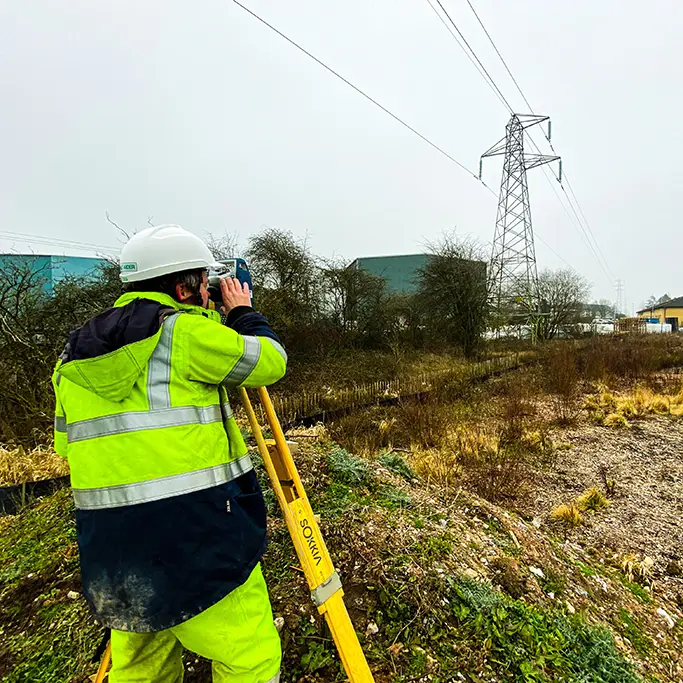
The Process:
How is a Swing Clearance Survey conducted?
Swing clearance surveys are usually conducted by a two-person team consisting of a surveyor and an assistant. First, the surveyor establishes control points using a survey grade GNSS (GPS) receiver to ensure the survey is located at Ordnance Survey OSGB coordinates. The advantage of using OSGB as a reference is that the recorded data can be overlaid on existing and proposed records. Once the survey location is established, the attachment points of the conductor are recorded as well as any features within the vicinity of the overhead line. Usually, these measurements are recorded with a Total Station, but we also use 3D Laser Scanners if the site is complex. After the field survey is completed, the data is downloaded back to the office, and a 3D model of the powerline is created. Once the 3D model has been analysed to determine the actual conductor sag and swing at the line's maximum operating temperature, a set of 2D profiles are produced to help understand the constraints. At this stage, any proposed development can be overlaid and a risk mitigation strategy can be discussed with key stakeholders.
The Benefits:
There is no price on Safety!
The Electricity Safety, Quality and Continuity Regulations 2002 (ESQCR) detail the UK's statutory requirements for power lines. Part of these requirements is to maintain a safe distance from live conductors. To comply with the regulations, all measurements must be determined at maximum conductor temperature. It's not enough to simply measure the distance to a conductor on site. Under fault conditions, a power line can sag significantly more than in normal operating conditions. A swing clearance survey ensures these factors are accounted for, thus ensuring compliance with the ESQC regulations. Using a specialist contractor to perform a swing clearance survey makes sure you comply with the law and prevents costly mistakes from relying on only basic measurements.
The Limitations:
What factors can limit certainty in outcomes?
Assessment confidence depends on available baseline data, representative assumptions, and site conditions that can vary over time.
Deliverables
Swing Clearance Drawings
We produce a comprehensive set of drawings that detail the swing clearance of the overhead line at maximum operating temperature, including the height of the line above ground level, staturoty clearance curves, and accurate distances to any proposed development.
Industry Standard Documentation
To satisfy ESQCR requirements, we produce drawings that comply with HSE GS6 & ENA 43-8 guidance. To produce this kind of documentation more is needed than to just measure conductor height. A surveyor needs to calculate the true conductor sag and swing during all phases of operation.
Expert Guidance
Once you have the documentation in hand, we can advise you on how to make progress with a DNO or Local Authority to get the necessary permissions to proceed with your project.